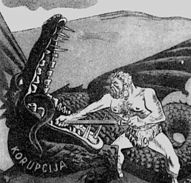

From Malpractice to Corruption.
Wallachia during the Eighteenth Century and Beyond*
The study of corruption during the Old Regime (mid-16th century to the mid-19th century) in South-eastern Europe has to face a deep-rooted prejudice and a blunt reality. On the one hand, the idea that institutions and public employees are exceptionally corrupt and that corruption is somehow inherent to the region’s culture and impossible to stamp out pervades much of public discourse. For example, when this project was advertised in the Romanian mass-media, a journalist called the author and asked to do an interview on the roots of corruption in Romania. The underlying assumption was that corruption runs like a red thread throughout Romanian history and it suffices to go back in time to find its origins. In addition, the invitation seemed to omit the multiple and significant changes that happened in the last three hundred years as well as the diversity of political and administrative traditions that preceded the making of modern Romania. Without denying the potential explanatory power of path dependency theory, I argue that we have always to pay attention to the historical contexts. On the other hand, the presence of corruption and of its negative effects in the life of citizens cannot be denied. Thus, one can ask, what the benefits of studying this phenomenon in the early-modern period would be since, it is believed, it continued undisturbed for centuries?1 Can one learn something from the history of corruption? Can we understand it better? Or are there lessons from the past that will help us deal with corruption in the present? The ancient dictum historia magistra vitae has been discarded by historians long ago as a reason to study history. Due to the singularity of events, a doctrine characteristic of the modern concept of history (Wolfgang Reinhart), the past can serve no lessons for the present or future. However, by studying the past, we can understand more about it. By studying the history of corruption, we can better understand what it meant in the past, how it changed and how people – governors and civil society – tried to control it. We can gain no direct instructions, but we can get better ideas. And here are a few reasons why I think such a complex phenomenon as corruption is worth studying.
The literature on corruption in early-modern world makes plain the fact that, far from being reserved to some regions and cultures, activities which we regard today as corrupt – trading of influence, favouritism, use of “public” office for “private” gain, gifts to those in power etc. – were commonplace. The fact is not so surprising when one thinks of preeminent role played by the patron-client networks in the recruitment of officials, of the proprietary forms of office-holding, of the blurred dividing line between private and public and the parallelism or competition of norms (Normenpluralität, Normenkonkurrenz). This alone is enough to dispel with the essentialist notion of corruption as an inborn characteristic of a culture/society/region.
Then, the study of corruption can reveal surprizing aspects about how societies reacted to administrative malpractice. My research focuses on 18th (and to a lesser extent 17th) century Wallachia. The analysis of the sources from the 17th and first half of the 18th centuries suggests, in line with the literature on early modern corruption, that administrative malpractice was treated on a case-by-case basis. Abuses were not automatically framed as corruption and the convergence of more factors were necessary for a formal accusation to be made and a trial to begin: repeated abuses, massive petitioning to the prince against one of his officials, an exceptional political event and so on. This situation began to change in the second half of the 18th century when the princes of Wallachia introduced a series of reforms meant to improve administration, taxation and justice and to put on a legal basis the relations between dependent peasants and their landlords. The reforms inaugurated a new style of government, one based on the issuing of frequent ordinances which regulated in detail the duties and rights of the office-holders, the relationships between tenants and landlords, the extraction of taxes, the keeping of administrative records, the organization of merchants’ and craftsmen’ guilds, the prevention of fires, the policing of the counties and so on. It is in these regulations, containing reprimands and warnings addressed by the Phanariot princes to central and local officials, that a preoccupation with the office-holders’ (mis)conduct surfaces. Other sources, judicial decisions, chronicles, memoirs, travelogues document how this preoccupation was turned into administrative practice.
Why were the reprimands and warning addressed to the Wallachian office-holder formulated or why did they appear now (during the second part of the 18th century)? Were they an older feature of the way princes governed Wallachia or it was a new development? How was corruption conceived during the 18th century and is there a change in comparison to the previous period? What mechanisms did the princes of Wallachia devise in order to curb officials’ misconduct? How did the boyars (the main recruiting pool of the office-holders) react to this policy? These were the questions that guided my research.
In short, I argue that during the second half of the 18th century a less indulgent attitude towards administrative malpractice emerged in Wallachia. This was due to a large extent to the particular situation of Wallachia with regard to the Ottoman Empire as a tributary principality, a relation which brought an ever-mounting fiscal pressure. Moreover, the frequent wars between the three neighbouring empires (Habsburg, Tsarist, Ottoman) generated periods of economic and demographic crises which determined attempts from the part of the rulers to reform the administration. Part of this reform was a stricter delineation of the officials’ responsibilities and obligations and the regulation of their income. Earlier, Wallachian officials were paid, like elsewhere, through the system of perquisites: fees and services collected from people in their jurisdiction and from subaltern officials. From 1740 on, the higher Wallachian officials started to receive salaries, while the perquisites (which remained the only form of remuneration for lesser officials) were limited and regulated. The growing importance of the idea of common good accompanied this process.
The regulation of office-holders’ responsibilities and duties entailed a significant transformation in the understanding of administrative malpractice. Several cases of embezzlement from the 17th century are documented, the most famous one from 1695, involving the clucer[1] Constantin Ştirbei. The latter took bribes, mis-assessed the taxes due by tax-payers and embezzled money from the tax he was entrusted to collect. But the prince accused him of being ingrate (for the favours the prince bestowed on him) and disloyal. In other cases, the embezzled money was treated like a debt to the prince. A century later the situation was quite different. Let us take for example the office of head of border district (vătaf de plai). Numerous ordinances establish the responsibilities and rights of these officials, including their pay, their precise and warn them to refrain from abuses. The stipulations of these ordinances are inserted in the letters of appointment. In 1785 the head of the Arefu border district was accused of establishing illegal sources of income, of acting beyond its jurisdiction and of committing various other abuses. Thus, the crimes he was accused of were in direct contradiction to the princely regulations. In other cases, these regulations are even cited or quoted. In short, if previously abuses were framed as treason of the prince or even debt to the prince (in case of embezzlement), from the second half of the 18th century, especially, from 1775 on, such activities were considered abuses of office which broke the law (i.e. the princely regulations) and damaged the common good. For, and this is another novelty in the 18th century Wallachia, the idea that princely rule and offices should serve the common good/interest/utility, and not some sectional or egotist interest, gained more and more ground. Hence, far from the image of a society in which corruption is a perennial and nonproblematic phenomenon, favoured by the culture of that society, we witness a shift in the way malfeasance is understood and a concern with it. Of course, this does not necessarily imply success in keeping corruption in check or reducing it. But the transformation is significant. This “invention of corruption” was a cyclical process: a larger and more complex apparatus was required to keep corruption in check; but, as the state grew, more opportunities for corruption arose and new anti-corruption measures were necessary.
The study of corruption also warns us against moralizing corrupt practices like bribery. Naturally, such a practice is unacceptable, but it doesn’t always imply moral lapses. In certain contexts, bribery is the only option for people to make ends meet. Moreover, curbing bribery or other corrupt activities hinge on numerous factors and usually on a combination thereof. Some of these factors that scholars invoke are an adequate legal frame, a free press, a transparent and incentivising remuneration for officials, efficient monitoring and political resolve, among others. Yet, there were other paths to reducing corruption. Denmark, currently regarded as the standard of successful anti-corruption, achieved decisive success during the time of absolutist monarchy and in the absence of a free press. Finally, even when favourable factors exist, palpable results are obtained after a long time.
Furthermore, the study of corruption casts light on a number of related phenomena in a society. The ambiguous status of nepotism, gifts, trading of influence describe a society marked by a plurality of norms, a proprietary conception of the office and a legitimate existence of patron-client relations. Similarly, the emergence of a discourse about corruption and of an administrative practice against it (anti-corruption) depicts a society which moves towards the modern conception of state and office and in which the border between private and public hardens. There is a great temptation among scholars to conclude their stories about corruption with a happy ending: either they detect a decline of corruption by the end of the period they have studied or they claim this decline at a later stage (which they did not study). Yet such conclusions are rarely defendable as corruption is able to adapt to new environments. As there are patterns of corruption specific to developing countries, there are patterns of corruption specific to developed countries. Therefore, while paying attention to the results of anti-corruption policies, it is also important to understand the meaning of corruption and anti-corruption at a given moment. In the words of James C. Scott, we have to ask “who gets what, when, how?”.
1 I am referring here rather to a widely shared belief and do not deny the constant molding of informality by the state.
[1] Official responsible with the provisioning of the princely court.
* This project has received funding from the European Union’s Horizon 2020 research and innovation programme under the Marie Sklodowska-Curie grant agreement No 89.
– Mihai Olaru (898155 — GenCorr, 2021-2023)



 Regensburg Corruption Cluster