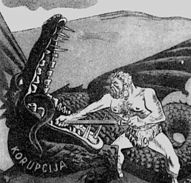
This three-year research project is a continuation of the interdisciplinary joint project “From Informality to Corruption (1817- 2018): Serbia and Croatia in Comparison”, which was funded by the DFG between 2020 and 2023. It deals with the understanding of corruption in Orthodox Christianity and focuses on the traditionally Orthodox countries of Russia and Serbia. The project contains three sub-projects from three different disciplines: a historical one (The Russian Orthodox Discourse on Corruption, 1856-1918 and 2000- 2023; applicant Klaus Buchenau), a management science one (The Church as Organization and Actor. Informality and Corruption in Serbia and the Role of the Serbian Orthodox Church (1991-2023), applicant Thomas Steger) and a linguistic one (Does the Church Speak Its Own Language? Secular and religious corruption lexis of Russian in transition (1856-1917 and 2000-2023), applicant Björn Hansen). The historical sub-project concentrates on what the Russian Orthodox Church understands by corruption and attempts a discourse-analytical longitudinal section. The management science sub-project deals with a shorter period of time, but has a broader research interest, because here the understanding of corruption also includes concrete practices and their organizational and legal requirements. The linguistic sub-project uses some of the same sources as the historical sub-project and subjects this material to a corpus linguistic analysis in order to find out how different secular and religious talk about corruption is in Russia. With this project, we want to make a contribution to research into the nexus of corruption and religion. There is hardly any qualitative research in this area, and Orthodox Christianity in particular is largely unexplored in this respect. There is a general view that Orthodox Christianity has historically contributed little to the fight against corruption, unlike Protestantism, for example. Our aim is not to decide this question – rather, we would like to shed light on what the Orthodox Church understands by corruption, how it is institutionally positioned in the fight against corruption and to what extent its concepts are compatible with those of the secular corruption discourse. At a time when “universal”, Western-led anti-corruption is being ground down in growing geopolitical rivalries, we believe it is important to engage more intensively with “autochthonous” sources of moral guidance, such as the Orthodox churches for Eastern Europe.
New Publication: From Grand Estates to Grand Corruption – The battle over the possessions of Prince Albert of Thurn and Taxis in interwar Yugoslavia | Brill, by Prof. Dr. Klaus Buchenau When Yugoslavia was created in 1918, noble landowners still possessed vast parts of its territory. This was especially true for the northwestern half of the country, which had formerly belonged to the Habsburg Monarchy. With about 38,000 hectares, prince Albert of Thurn and Taxis was the largest private owner of forests in the new kingdom. Yugoslav politicians demanded an expropriation, justified as social and historical justice. At the same time, political and business networks attempted to channel the property into their own pockets. The involved sides – Thurn and Taxis, Yugoslav officials, national and international companies – used various means to struggle for their interests, from lawsuits to international arbitrage and political lobbyism. This book concentrates on the latter, arriving at a “grammar of bribery” in the wood business of interwar Yugoslavia.

Workshop: The future of corruption studies, Cres, 28 September – 2 October 2022.
This meeting of the Regensburg Corruption Cluster and its partners was designed to help our doctoral students and the postdoc to finalize their projects, but also to develop follow-up ideas for the further development of the cluster.
Klaus Buchenau: Opening talk
Thomas Steger: The future of corruption studies from a business & management perspective
Free discussion session
Mihai Olaru: Varieties of corruption in 18th century Wallachia
Miloš Lecić: Corruption Serbia and Croatia in the “short” 20th century, 1914-1989
Barbara Frey: Agrokombinat and Agrokor; Survey on the perception of corruption and informality among Croatian SMEs owners and managers
Jovana Jović: Corruption in mass media: A frame-semantic analysis of the Agrokomerc scandal based on newspaper articles from Politika
Damjan Matković: The Railway Affair (1882-1891)
Aram Simonyan: Ideas on a postdoc project
Conference: Informal practices in Southeast Europe – Examples and Analyses. Institute for the Recent History of Serbia (Institut za noviju istoriju Srbije/INIS), Belgrade, 10–11 April 2022

Our team participated in this two-day conference on the informal practices in Southeast Europe. It was an exceptional opportunity to familiarize ourselves with the latest developments in an emerging field, where the topics centered on both the historical continuities of informal practices in the region and on new emerging methods for classification and comparison of informality. We presented on four different topics, providing an overview of the research currently being conducted by our Regensburg cluster:
Mihai Olaru: The Notion of ‘Common Good’ in 18th Century Wallachia and Its Role in the Definition of Corruption
Damjan Matković: Informality and Corruption in Serbia 1817–1914
Jovana Jović and Miloš Lecić: From Corruption to Informality: An Interdisciplinary Cooperation between Historians and Linguists
Barbara Frey: Corruption and Informal Practices in Business: Focus on Serbia and Croatia
The lively debate following both our and the presentations of our colleagues, made it clear that approaching the topic of corruption through the lens of informality provides a substantially more productive way forward, that is rooted in actual practices rather than the top-down anti-corruption policies and narratives.
LMU München, Prof. Dr. Klaus Buchenau, 10. Februar 2021, Colloquium zur Osteuropäischen Geschichte
Vortrag: Wald, Gewalt und Geld. Das Haus Thurn und Taxis, kroatische Bauern und jugoslawische Politiker im Kampf um die Holzreserven Kroatiens, 1919–1941
ASEES virtual convention, Prof. Dr. Klaus Buchenau, 5-8 November 2021, Panel “Beyond Anti-Corruption Campaigns: The Social and Cultural History of Corruption in Late Socialism“
Presentation: A Third Way into Twilight?: Corruption and Anti-Corruption in Socialist Yugoslavia
Universität Regensburg, Prof. Dr. Klaus Buchenau, 12-14 Uhr, SoSe 2020
Vorlesung: Illegitime Bereicherung. Eine Geschichte der politischen Korruption in Europa
University of Zagreb, Prof. Dr. Klaus Buchenau, 23-24 September 2020, Conference „Transitions out of Empire in Central and Southeastern Europe“
Presentation: The Nationalisation and Restitution of the Thurn and Taxis Forests in Croatia (1919-1941). A Case Study on the Interplay of National, Post-Imperial and Criminal Elite Networks
Samostan sv. Franje, Cres, 23-30 September 2020, Workshop “Informality and Corruption through the Interdisciplinary Lens”
Presentations from invited guests and discussions on the individual projects of the Regensburg Corruption Cluster (report published in COMPSEES 70/2, 358–378)
University of Rijeka, Prof. Dr. Klaus Buchenau, 21 October 2020, Regensburg – Rijeka Lectures: New Trends in Southeast European Studies
Presentation: A Grammar of Bribery – developed on the struggle over the Thurn and Taxis forests in Croatia (1919-1941) (aufgezeichnet per Zoom)
Continuation (approved June 2024): Corruption and Religion – Orthodox Christianity in Russia and Serbia / funded for 36 months by the German Research Foundation

 Regensburg Corruption Cluster